
Councils Can Demand Your Tenancy Paperwork from 27 December 2025
Since 27 December 2025, something quietly changed - local councils now have stronger powers to inspect landlords’ properties and demand documents relating to the last 12 months.
Since our last update on the Renters’ Rights Act 2025, most of the conversation has focused on the big implementation date of 1 May 2026. However, while many landlords have been looking at the horizon, a significant shift has already happened.
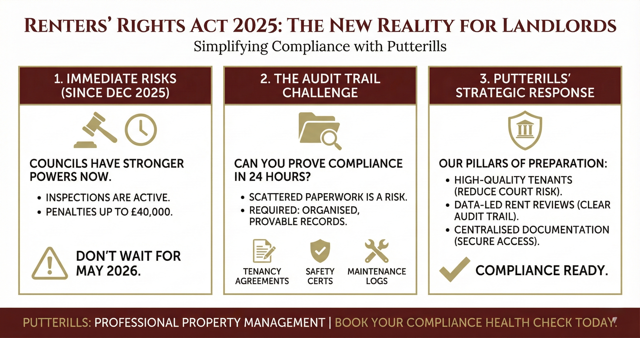
Since 27 December 2025, local councils have gained stronger powers to inspect rented homes and request documentation covering the last 12 months. This isn’t about whether you are a “good landlord,” it is about whether you can prove you are compliant quickly, with a tidy audit trail. In plain English: if you cannot produce the paperwork promptly, you are immediately on the back foot.
The Enforcement Reality "Operation Jigsaw"
The reason this matters is simply the enforcement landscape is changing just as quickly as the legislation. Local housing authorities have received £18.2 million this financial year to build enforcement capacity, coordinated through a national programme known as Operation Jigsaw.
The name might sound harmless, but the government's intentions are not. Guidance sets out civil penalties of up to £7,000 for administrative breaches and up to £40,000 for serious or repeat offences.
These are not rare edge cases. They are the types of issues that occur when landlords improvise, miss a step, or rely on old templates:
Incorrect Possession Notices: Attempting to end a tenancy orally, or by using the wrong notice, can trigger a £6,000 penalty.
Procedural Errors: Trying to regain possession outside the prescribed legal process also starts at £6,000.
Discrimination: Blanket restrictions in the lettings process (e.g., against families or those on benefits) start at £6,000.
Rental Bidding: Inviting or accepting rent above the advertised figure starts at £4,000.
Licensing Failures: Where a property should be licensed under a selective scheme but is not, the starting point can be £12,000.
Why This Has Arrived Now
The practical answer is that the Government wants the sector “inspection ready” before the more disruptive reforms land in May. By activating investigatory powers early, councils can build enforcement capacity, test their processes, and identify non-compliance ahead of the end of Section 21.
Ask yourself honestly: If the council asked tomorrow, could you produce a complete compliance file for the last 12 months within 24 hours?
What Councils Can Ask For
Councils are looking for the basics, but they want them organised, complete, and provable. This includes:
- Tenancy agreements and deposit protection documentation.
- Right to Rent records.
- Gas Safety, EICR, and EPC paperwork (and evidence they were served correctly).
- Repair and maintenance logs showing what was reported, what action was taken, and when.
This is where landlords get caught out not because they’ve done something shocking, but because documents are split between inboxes, WhatsApp threads, and paper folders. Under scrutiny, “I’m sure it exists somewhere” is a dangerous position to be in.
How Putterills is Preparing Our Landlords
We have evolved our management systems specifically to address these new risks, focusing on three core pillars:
Tenant Quality is Paramount: With the safety net of Section 21 disappearing, the best way to prevent repossession delays is to avoid the courts entirely. We focus on placing high-quality, properly vetted tenants with clear affordability and stable track records.
Procedural Care for Rent Increases: Section 13 is now the standard route for increases. We use a structured system that creates a clear audit trail, backed by up-to-date rental comparables reflecting both asking and achieved rents to support you if a tenant challenges the increase at a Tribunal.
Centralised Compliance Documentation: We secure all your documentation in one place, linked to your tenancy record. This ensures we can respond instantly to any request and protects you from the most common compliance issue: being unable to prove that a legal requirement was met.
Is Your Paperwork Ready?
The era of casual landlording is ending. The sector is moving towards professional standards and a provable audit trail. If you are currently self-managing, or if your paperwork is split across several places, we can help you tighten this up before the May deadline.
Would you like us to carry out a complimentary "Compliance Health Check" of your current tenancy file to identify any gaps and get you inspection-ready?