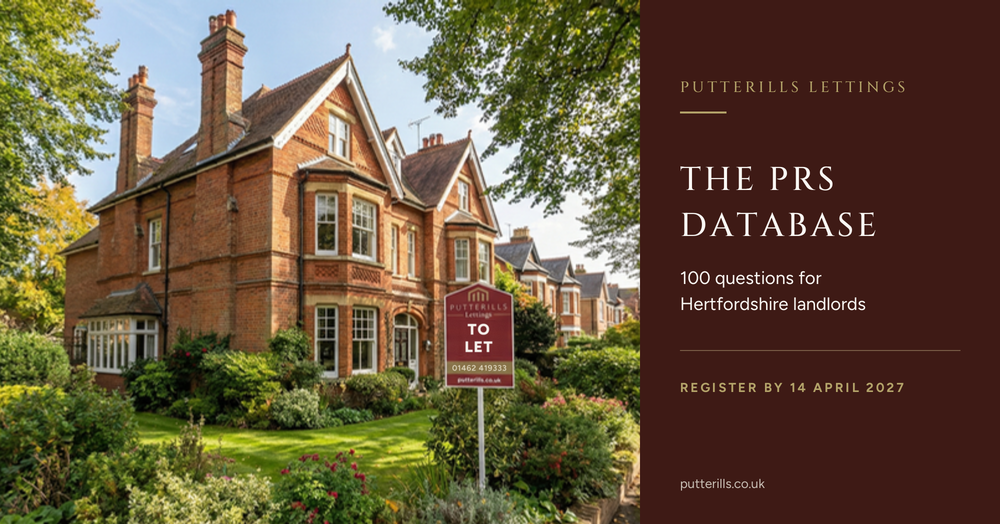
The PRS Database 100 Questions for Hertfordshire Landlords
From 15 January 2027, every landlord letting a home in Hertfordshire on an assured tenancy must register themselves and the property on the Government's new database, with a deadline of 14 April 2027. Here are the 100 questions landlords are asking us, answered plainly.
If you let a home in Hertfordshire, you will need to register yourself and the property on the Government's new database by 14 April 2027, and the clock starts on 15 January. Here are the 100 questions landlords are asking, answered plainly.
The five things that matter
1. Hertfordshire's rules take effect on 15 January 2027 and the deadline is 14 April 2027. You can register from 15 December 2026.
2. You register yourself and each property. Only you can start it; your agent can add details.
3. It costs £65 per property per year.
4. For a let property, the tenancy and safety details must be added within 28 days of the entry, or it lapses.
5. Penalties run to £7,000, and courts will not make most possession orders while you are unregistered.
The basics
1. What is the PRS Database?
A new national register of private landlords and the homes they let in England, created by the Renters' Rights Act 2025. The Government's online service is called Register your rental property. Every landlord letting on an assured or regulated tenancy will need an entry for themselves and one for each property.
2. Why is it being introduced?
To give tenants, councils and the Government one view of who lets what. Tenants will be able to check a landlord is registered, and councils get the information they need to focus enforcement on the landlords who ignore the rules. For landlords who already do things properly, it is mainly an administrative job.
3. Is registration compulsory?
Yes, for landlords letting a home in England on an assured or regulated tenancy. It is not an accreditation scheme, and there is no exemption for small landlords.
4. Does it apply across the UK?
No, England only. Wales has Rent Smart Wales, and Scotland and Northern Ireland have their own landlord registers.
5. Am I registering myself or the property?
Both. You make a landlord entry for yourself or your company, then a separate property entry for each home you let. A property cannot be entered until you have an active landlord entry.
6. Does it replace licensing, deposit protection or anything else?
No. HMO, additional and selective licensing carry on as before, as do deposit protection, Right to Rent checks, gas and electrical safety, and your tax obligations. The database records some of that information; it replaces none of it.
7. Is it the same as the new landlord ombudsman?
No. The Renters' Rights Act also creates a landlord ombudsman, which landlords will have to join. That is a separate scheme coming later, and registering on the database does not enrol you in it.
8. Does registration mean my property is approved as safe?
No. The database records what you tell it. It is not an inspection or an approval, and councils can still inspect and act where a home falls short.
Who must register
9. I only have one rental property. Does this apply to me?
Yes. There is no minimum. A landlord with one flat in Stevenage has the same duty as a landlord with fifty houses.
10. My tenant has been there for years. Can I wait until they leave?
No. During the rollout, properties that are already let must be registered, so a long-standing tenancy is covered. In Hertfordshire that means by 14 April 2027.
11. We own the property jointly. Does only one of us register?
Each joint landlord needs their own landlord entry. The property is entered once, naming the landlords, and one fee is paid for it.
12. The property is owned by a limited company. Who registers?
The company registers as the landlord, with its Companies House number and contact details. Someone with authority to act for the company makes the entry.
13. What about trusts, inherited property or a power of attorney?
The rules let certain people make entries for a landlord, including an attorney, a court-appointed deputy, a personal representative of someone who has died, a trustee and a receiver. They must provide evidence of their authority, such as the power of attorney or the grant of probate.
14. I live overseas. Am I exempt?
No. You will need a correspondence address in England or Wales, and it cannot be a PO Box.
15. I let to a family member, or below market rent. Does that change anything?
Not if the arrangement is an assured tenancy. The rent and the relationship do not decide it; the type of tenancy does.
16. Do I need to register because I have a lodger?
Generally no. A lodger who shares your home has a licence, not an assured tenancy, so the arrangement falls outside the database.
17. What about holiday lets?
A genuine holiday let is not an assured tenancy, so it is generally outside the database. A home let to someone living there, under the label of a holiday let, is a different matter.
18. Are student houses included?
Yes, where they are let on assured tenancies, which most private student lets are.
19. Does an HMO need one entry, or one per room?
The database is built around the dwelling, and it records the number of occupants and households living there along with the HMO licence details. Talk to us before you enter a house let room by room, so it goes in correctly.
20. What if the property is let to a company?
An assured tenancy has to be granted to an individual, so a let to a company is generally outside the database. If the employee holds the tenancy in their own name, it is in.
21. What about rent-to-rent arrangements and leasehold flats?
The landlord who grants the tenancy to the occupier registers. The entry also records any freeholder or superior landlord and the property manager, so it shows who sits above the landlord.
22. Are any tenancies excluded altogether?
Supported exempt accommodation, as defined in the Supported Housing (Regulatory Oversight) Act 2023, is excluded. Otherwise, if you let a home in England on an assured or regulated tenancy, assume you are in.
Dates and deadlines for Hertfordshire
23. When does registration open?
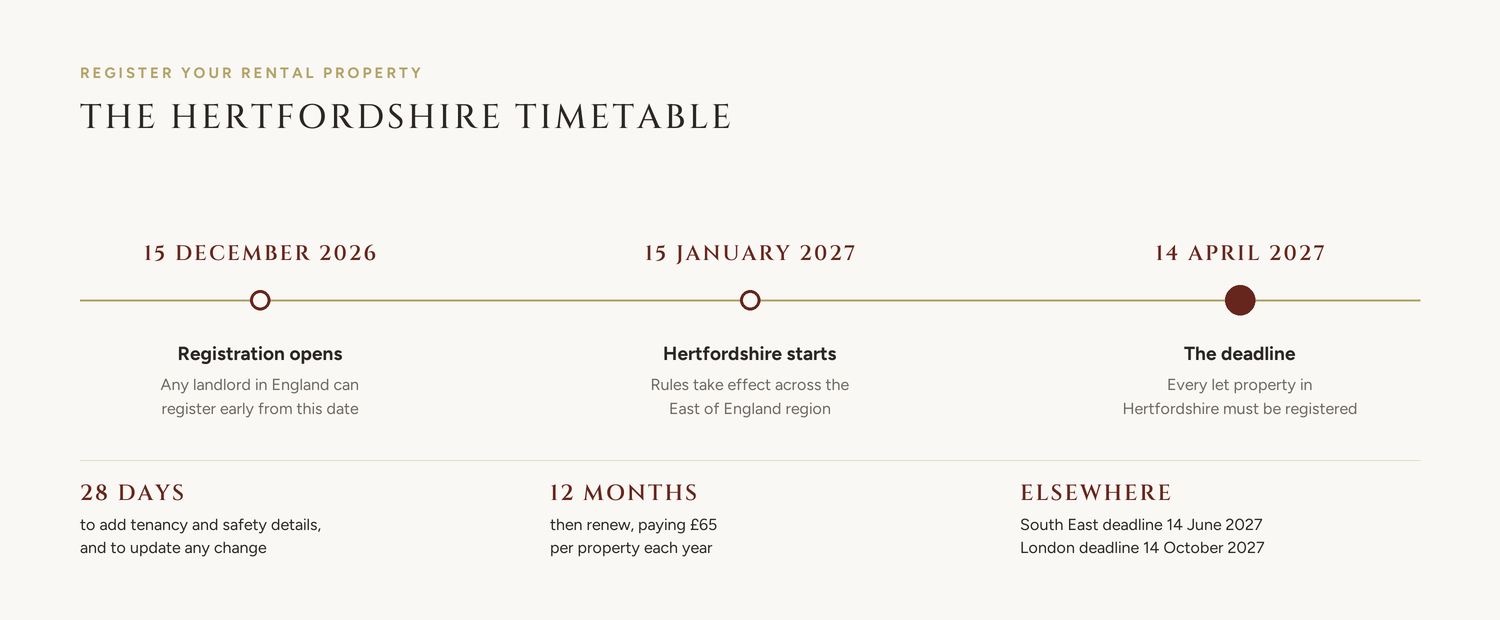
The service opens on 15 December 2026, starting with the West Midlands. Landlords anywhere in England can register from that date.
24. When does it start in Hertfordshire?
Hertfordshire is in the East of England region, where the rules take effect on 15 January 2027.
25. What is the deadline for Hertfordshire properties?
14 April 2027. Every let property in the county, from Hitchin and Letchworth to Stevenage and Welwyn Garden City, must be registered by then.
26. Does my home address decide the deadline?
No, the property's location does. A landlord living in London with a house in Hitchin has the Hertfordshire deadline of 14 April 2027 for that house.
27. What if I own property in other regions too?
Each property follows its own region's timetable. Luton, Bedfordshire, Cambridgeshire and Essex are also in the East of England, with the same April deadline. The South East deadline is 14 June 2027 and London's is 14 October 2027.
28. Can I register early?
Yes. You can register from 15 December 2026, including properties in several regions at once. The Government says the fee will be pro-rated during the rollout, so registering early should not cost more.
29. My property is empty. Must I register it now?
Not during the initial rollout. For now, only properties that are let, or become let during the rollout, must be registered. Later rules will require empty properties to be registered before they are marketed.
30. What if I start a new tenancy during or after the rollout?
A property that becomes let during the rollout must be registered by 14 April 2027. After that date, any property you let must have an active entry, so build registration into the move-in checklist.
31. Will I get a letter telling me to register?
Do not wait for one. The duty sits with the landlord whether or not you are contacted, and councils can start enforcement once the deadline has passed.
32. Why register in the first weeks rather than the last?
Because an occupied property's entry lapses if the tenancy and safety details are not added within 28 days, and because the last fortnight before a deadline is when the service and the helplines will be busiest. Register in January or February and there is time to put anything right.
What you will need
33. How do I register?
Online, through the GOV.UK Register your rental property service, using a GOV.UK One Login. An offline route and a contact centre are available for landlords who cannot use the online service.
34. I already have a GOV.UK One Login. Am I registered?
No. One Login is only the way into the service. You are registered once your landlord entry and each property entry are complete and active.
35. What personal details will I need?
Your name, date of birth, residential address, telephone number and email address.
36. What if I let through a company or other organisation?
The organisation's details, legal entity type, address and contact details, its Companies House or charity number where it has one, and details of directors, trustees or partners where it does not.
37. What property details are needed?
The address, ownership type, dwelling type, number of bedrooms, whether it is currently let, your correspondence address, and details of any freeholder, superior landlord or property manager.
38. What tenancy details are needed?
The number of occupants and households, any HMO, additional or selective licence, and whether the property is furnished.
39. Which rent figure goes in?
The current rent, how often it is paid, and whether any utilities are included in it.
40. What gas safety information is needed?
Whether the property has a gas supply and, if it does, the gas safety record and its issue date.
41. What electrical information is needed?
The Electrical Installation Condition Report, or an appropriate Electrical Installation Certificate, and its date.
42. What about the EPC?
The EPC information, and details of any minimum energy efficiency exemption registered on the PRS Exemptions Register.
43. My EPC has expired. Do I need a new one just to register?
Not necessarily. An EPC is needed when a property is marketed or let, and where the latest EPC has expired the database asks for the tenancy start date instead. Check with us before ordering a new one.
44. Do I upload tenant names, passports or the tenancy agreement?
No. The published list asks for the number of occupants and households, not names or identity documents, and it does not ask for the tenancy agreement.
Making the registration
45. In what order do I do things?
Create your landlord entry first, then a property entry for each home, paying the fee for each property as you go.
46. Do I need every document before I start?
For a property that is already let, have them ready. The tenancy and safety details must be added within 28 days of the entry being made, or the entry becomes inactive.
47. Can I create my landlord entry now and add properties later?
Only for a short while. A landlord entry becomes inactive if no property has been linked to it within three months.
48. How will I know registration is complete?
Each landlord and each property is given a unique identifier, and the entry shows as active. Keep a record of both identifiers and your renewal date.
49. Can I register several properties at once?
Yes, including properties in different regions. Each property is a separate entry with its own fee, and properties you add later take the renewal date of your existing ones.
50. What if I cannot use the online service?
An offline route is available, and a contact centre will support registration and renewal. Ask early if you need it.
51. What if the website shows an error or the payment fails?
Take a screenshot, note the time, and try again later rather than paying twice. Keep that record: it shows you tried to register in time.
52. Who can make the entries for me?
Only you, or a person with legal authority to act for you, such as an attorney, deputy or personal representative. A letting agent cannot create the landlord or property entry.
53. Can anyone check what I have entered?
Yes. The database operator and local councils can verify entries, and correct or remove them.
54. What if I enter something wrong by mistake?
Correct it as soon as you notice; entries must be kept up to date within 28 days. The offence in the Act is knowingly or recklessly giving false or misleading information, which is not the same as an honest slip put right promptly.
Letting agents and Putterills Lettings
55. Can Putterills Lettings do the whole registration for me?
No, and no agent can. The rules require the landlord to start and finish the registration and to make the landlord and property entries. What we can do is make sure you have everything ready, and add the details an agent is allowed to provide.
56. What can an agent add?
Once you have made the property entry and appointed us, we can provide the tenancy and safety information: occupants and households, licensing, gas, electrical and EPC details, rent and furnishing. We can also update whether the property is let.
57. How will I give Putterills access?
The Government has promised detailed guidance for agents before launch, including how access is given. We will confirm the steps to every landlord we manage once it is published.
58. What will Putterills do before registration opens?
Putterills Lettings will contact every landlord whose property we manage before registration opens, with the details we hold for that property, ready to enter.
59. My property is fully managed. Am I still responsible?
Yes. The legal duty to register, and responsibility for the information, stays with the landlord even when an agent supplies part of it.
60. Can Putterills keep the entry up to date afterwards?
For the tenancy and safety details, yes, once you have appointed us. Changes to your own details, such as a new address or a change of ownership, remain yours to update.
61. What happens if I change letting agent?
The property entry records the property manager, so it needs updating within 28 days of the change.
62. I am a let-only landlord with Putterills. What applies to me?
The same duty. You will usually be the one keeping the entry current after the tenant moves in, and we can tell you what is needed at the start of each tenancy.
63. Does Putterills already hold my certificates?
For the properties we manage, we hold the gas, electrical and EPC records on our lettings system, and we are checking every property's records ahead of January. Where something is missing or out of date, we will tell you.
64. I let my property myself. Can Putterills help?
Yes. Putterills Lettings can talk you through what the database needs and how our management service would handle it. Call the lettings team on 01462 419333.
Fees
65. How much does registration cost?
£65 per property per year. One property costs £65; five cost £325.
66. Is there a fee for my landlord entry?
The published fee is per property. The rules require a fee before a property entry is made, on renewal, and on some reactivations.
67. Do joint landlords each pay?
No. The fee is per property, so a jointly owned house is one entry and one fee.
68. Will everyone pay the full £65 at the start?
Not necessarily. The Government says the fee will be pro-rated during the rollout so early registrants do not pay more. The pro-rated amounts have not been published.
69. Can I charge the fee to my tenant?
No. Under the Tenant Fees Act 2019 a landlord can only charge tenants permitted payments, and a registration fee is not one of them.
70. Does a new tenancy mean another fee?
No. The fee is annual, per property. A change of tenant means updating the entry, not paying again, as long as the entry stays active.
71. Who pays the fee?
The person making the property entry, which in practice means the landlord.
72. Could the fee change?
Yes. The fee is set by the database operator rather than fixed in the regulations, so it can change. No discounts or refunds have been announced.
Keeping your registration up to date
73. Is registration a one-off?
No. Entries must be renewed every 12 months and kept up to date in between.
74. What is the main deadline after registering?
28 days. Information that goes out of date must be updated within 28 days of it changing.
75. Is that 28 working days?
No. The rules count 28 days beginning with the day the information went out of date, so these are calendar days and the day of the change is day one.
76. When does the rent need updating?
When the new rent takes effect the old figure is out of date, so update it within 28 days of the increase starting, not when the notice is served.
77. What happens when a safety certificate is renewed?
The new gas record or electrical report goes on the entry in place of the old one, within 28 days.
78. What happens when a tenant leaves?
Update whether the property is let, within 28 days. When you re-let, the new tenancy details follow the same 28-day rule.
79. My property was empty when I registered. When do the tenancy details go in?
Within 28 days of the tenancy starting.
80. Does the 28 days mean I can let an unregistered property for four weeks?
No. The 28 days is for adding or updating details on an entry that already exists. Once the deadline has passed, the property itself must be registered while it is let.
81. When do I renew?
Every 12 months from your first registration. Properties you add later take the same renewal date as your existing ones, so a portfolio renews together.
82. Is there a grace period after renewal is due?
No. An entry becomes inactive the day after its renewal date unless it has been renewed.
83. Why else might an entry become inactive?
A property entry lapses if the tenancy and safety details are not added within 28 days. A landlord entry lapses if no property is linked to it within three months, or when your last property entry becomes inactive.
84. What if I sell the property or stop letting?
Deactivate the property entry. A buyer who intends to let can make their own entry, and the rules allow them to do that before yours is closed.
Penalties and enforcement
85. Who enforces the rules in Hertfordshire?
The district and borough councils: North Hertfordshire, Stevenage, Welwyn Hatfield and East Hertfordshire across our area, and the other Hertfordshire councils elsewhere in the county.
86. What happens if I miss the deadline?
The council can impose a financial penalty of up to £7,000 for failing to register.
87. When can it reach £40,000?
When there is an offence: knowingly or recklessly giving false or misleading information, carrying on a breach for more than 28 days after a penalty, or a further breach within five years. The council can then impose a penalty of up to £40,000 or prosecute.
88. Does paying a penalty let me stay unregistered?
No. Carrying on for more than 28 days after a penalty is itself an offence.
89. Could I have to repay rent?
Some database offences are among those for which a tenant or council can apply for a rent repayment order, and those orders can now reach up to two years' rent.
90. Can I recover possession if I am not registered?
In most cases, not through the courts. A court cannot make a possession order while the landlord is in breach of the duty to register, unless the claim is on the anti-social behaviour grounds, Ground 7A or Ground 14.
91. Does an unregistered property make the tenancy invalid?
No. The Act says a breach does not make the tenancy unenforceable, and the tenant still owes the rent.
92. Can I challenge a penalty?
Yes. The procedure in the Act gives you notice and the chance to make representations, and a final penalty can be appealed to the First-tier Tribunal.
93. Will councils see my information?
Yes. The Act gives access to local councils and certain other enforcement bodies, and councils can add entries of their own, such as banning orders and penalties.
94. Will tenants see my home address and documents?
Some information will be public so that tenants can check a landlord is registered. The Act leaves the detail of what is shown to regulations, and that has not yet been confirmed.
Getting ready
95. What should I do before 15 January 2027?
Set up a GOV.UK One Login, gather your personal or company details, and check that each property's gas record, electrical report and EPC are in date and to hand.
96. How should I organise a portfolio?
One line per property: address, ownership, bedrooms, occupants and households, licence, rent, and the date of each certificate. With that in front of you, each entry takes minutes.
97. What routine works after registration?
Put your renewal date in the diary, and treat every change of rent, tenant, certificate or agent as a 28-day update.
98. What if I find I have missed a deadline?
Register straight away, keep a note of when you did it and why it was late, and bring the property's details up to date. Do not leave a property unregistered while you decide what to do.
99. What is still to be confirmed?
The regulations are still in draft, awaiting Parliament's approval. Guidance for agents, the pro-rated fees and what information is made public are all still to come.
100. Who can I speak to at Putterills?
The Putterills Lettings team, on 01462 419333 or at lettings@putterills.co.uk.
Jeremey Godfrey
Director
Putterills

This guide is general information for landlords letting homes in England, written on 28 October 2026 from the Renters' Rights Act 2025, the draft Private Rented Sector Database Regulations 2026 and the Government's published guidance. It is not legal advice for your circumstances, and the final rules should be checked before you rely on any detail.